Posts

Showing posts with the label Fantasy Writing

A Never Ending Cycle

Image
Part of launching into this industry is the continual creation process. The development of Tortured Earth was a means to an end - the development of a framework in which a broad range of stories could be told. Now that the system is finalized, the process of storytelling must begin. Kevin and I are currently focusing on the development of one-shot adventures. These kits are retrofitted from the 2.0 Core Ruleset and give players a taste of the system without having to invest in multiple books. Other game systems have developed similar products for the same goal. The Rules Lite versions allow for replayability while the core books provide the full flexibility of the system. A creative GM will be able to adapt the Rules Lite version for homebrew adventures fitting in the world setting for which the kit was built. Currently in the editing phase are four such adventures. Two have been completed and are already in production and being distributed through the convention circuit. Eventually, t...

Ahhh . . . . A Break from Editing

Image
Those of you following this short list of blogs quickly realize my deep loathing of editing. In terms of the mountain of tasks involved with owning, operating, and writing your own games, editing is the least favorite. Actually, it does make the top of the list for most despised. Last night, I was able to work on the basic mechanics for attaching items to pre-existing weapons and implements. It was refreshing. Without sounding like an advertisement, the systems are now in place to create and attach components. The concept isn't all that foreign to role playing systems. What I accomplished last night allows those attachments to operate more like modular Leggo blocks - attaching and detaching from items with appropriate crafting checks. The beauty of the project allowed me to push back into creating mode. Fortunately, the editing process has honed my self-editing skills. With a little hope, there will not be quite as much revamping as we found in the non-weapon skill section.  Tra...

Thoughts on Game Design

Image
As a designer of my own system, it's easy to lose sight of the fact other systems exist. I'm not talking about the established games systems having 40+ years on the market. I'm talking about new games floating just beneath the surface of the market. Those systems, like my own, struggling to hit that 'mainstream' designation. The reason I even started designing my own system was quite by accident. Artice and I were sitting at a camp trying a few new beers I'd picked up at our local wine shop - Marcello's in Lafayette, LA for those interested. As so many of our conversations, we'd drifted toward gaming.  The conversation started simple enough - what we didn't like about D&D 4.0. We compared it to other systems and previous versions. We launched into a lot of "if I were to make it" or "if they changed this" kind of talk. At one point, Artice turned to me and said, "You know what we're doing, right? We're making a ...

Homebrewing Creatures - Creating Creature Abilities

Image
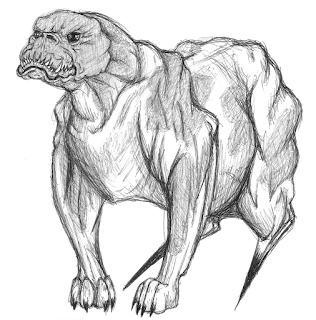
*For image credits as published, please see Fetid Hound creature sheet. Creature Abilities Creature Abilities represent the skill set a creature naturally possesses. Unlike character skills, these are not limited to uses per day nor independent advancement. For this discussion, we'll compare the Wolf and Fetid Hound in their Ability design. Based on Attribute design, it would appear the Wolf has a higher than expected attribute pool than suggested. However, it should be noted, the wolf increases a size category at Rank 5. As mentioned at the end of the article, creature creation is not a process set in stone. The creature does have additional bonuses to hit when starting at lower ranks. However, the damage it deals is also set quite low. The idea is to balance bonuses and damage to create playable encounters. When placing the wolf and fetid hound next to one another, it is evident both are canine body forms. Attribute distribution between the two forms is wildly different. Wol...

Homebrewing Creatures - Distributing Attributes

Image
Visualizing creatures has become second nature to me. Fortunately, I've always had a very active imagination and writing provides an outlet for the things I envision. When creating creatures, I usually begin with the physical description and expand into the general description of its abilities. Once I've got the concept on paper, the creature needs to be converted into a playable form. The Creature Blank can be downloaded by clicking the link. The file is a Word Blank and can be modified to create your own creatures. A few tips on allocating attributes: Don't power stack. Creatures will develop strengths based on their lifestyle and have attacks which center on those strengths. However, nothing is solely dedicated to a single attack sequence. Real world examples include lions which have been observed to open car doors, squirrels solving complex puzzles to gain food, and crows demonstrating amazing abilities at memory recall and problem solving. If we power stack attribu...

Creating a Campaign - Final Conflict/Resolution

Image
As mentioned, the Storyboard segment of the campaign comprises the largest part of the overall story. For those thinking in terms of writing for publication, this phase usually runs a page count between 40 to 60 pages - largely depending upon the number of storyboards the writer puts into action. Once maps are added into the mix, the page count can easily exceed 80. For the homebrewed adventure, this usually represents several months of gameplay.  Final Conflict Once all Storyboard segments have reached their conclusion, a transitory event is usually triggered. The characters are forced to either make a stand or face the boss creature or some other epic confrontation. When writing my first adventures, I somehow equated this to a massive creature. The mechanics of large scale war or conflict was difficult for me to conceptualize - especially from a writer's perspective. To gain a handle on the mechanics, I had to shift my perspective from an omniscient view to the character's...

Creating a Campaign - Storyboard

Image
As indicated in the previous post, the Introductory Phase serves to lay out the pieces of a much larger puzzle. Characters are introduced to all components required to launch the story. The during this phase, specific roles and character profiles occur at face value. Nefarious schemes and criminal masterminds are not introduced during this story component. The Storyboard phase takes the personalities introduced and broadens their interaction with the players. This is also the section which follows the standard story cycle taught in high school English classes: Introduction, Rising Action, Conflict, Resolution. Tortured Earth stories usually have 2 - 3 such adventures. Each adventure leads the characters to discover new components on a much larger story arch. Each adventure also is a contained story cycle - giving the players a sense of accomplishment at the end but also posing new questions as to the larger workings around them. In Mountains of Mists and Mystery, a ranger is killed ...

Creating a Campaign - Introductory Phase

Image
The hardest part of beginning an adventure is, well, the beginning. The first setting is always the hardest to peg down and it is the most important. The very first scene sets the tone of the story, begins the character introduction process, and often fixes the opinions and views which the characters will maintain for the first few sessions. It's the really important bit. The Opening The standard opening scene is a tavern or bar. It is a classic opening and, honestly, is reliable. If there isn't a watering hole in the opening scene, it won't be long before the characters seek one out. It's a comfortable setting players can identify as a source of information, familiar faces, and discrete trade. If you're looking for a printable tavern generator, one is available on the website: Tortured Earth Generators . The generator is an Microsoft Excel creation, so you will need to download the free version to run it. I like to begin adventures completely throwing players ou...

Creating a Campaign - Where to Begin

Image
Creating a campaign can be a daunting task - mainly because the writer only sees the finished product with all the illustrations, maps, and cover art. In reality, it is not a difficult job. Don't get me wrong, it's a lot of work but it's a fun type of work. There are all sort of books and tools and guides on the web on how to create various types of stories. I've read quite a few on writing novels hoping to adapt narrative strategies to the module creation process. I won't bore you with the summaries of all my examinations into the process. I will say this: The story cycle followed by novels and short stories is adaptable to the module writing process. However, the actual writing style is wildly different.  A module writer must create the setting in which the characters move. We are the sensory organs through which the character perceives their world. The make available to them the sights, smells, sounds, and touch they experience. In some cases, we also reveal t...

The Joys of Editing

Image
Those of you seeking inspiration and motivation during the trials of your editing process should turn away now. This is not a perky, upbeat review of the process. Rather, it is a truthful examination of the pains and realities of something incredibly unpleasant.  One would think the actual creation of the game, painstaking playtesting, and writing of the rules would be the worse part of the process. After all, to adequately play test and evaluate rules can take years of trial and error. It would seem this is the worse part of the process. Editing should be a simple matter of review spelling errors and correcting grammatical mistakes. Right? Wrong. It is a dreadful line-by-line review of your writing completed during breaks, hours after children went to bed, stretches of time between getting home from work, walking the dogs, and going to bed. It is tedious, time consuming, and miserable. Making it worse, it can't be done by the writer(s) but must be overseen by the writer(s)....

Independent Game Developing

Image
In promoting Tortured Earth, I find myself bouncing from convention to convention a lot. As a result, I tend to meet a wide variety of new game developers - all asking the same basic question: How'd you do it? Honestly, I wish I had someone to drill with that very question. At the time we published, there were a lot of vague internet resources out there. Tidbits of information here and there. Good sounding advice. etc. There really wasn't anyone simply willing to open up and spell it out. The best advice I can start with is:  Don't quit your day job . This may sound a little disheartening, but in reality it's quite sound. When we started out, there were shameless visions of instant success. Droves of fans and all the other unrealistic fantasies that go along with creating your first large work. The truth is this: The large companies have a huge chunk of the fandom and the fans are simply not open to trying something new. Our first venture into a game shop was disastr...